Guitars of Love
 ...guitar/bass
pre-amp
...guitar/bass
pre-amp
|
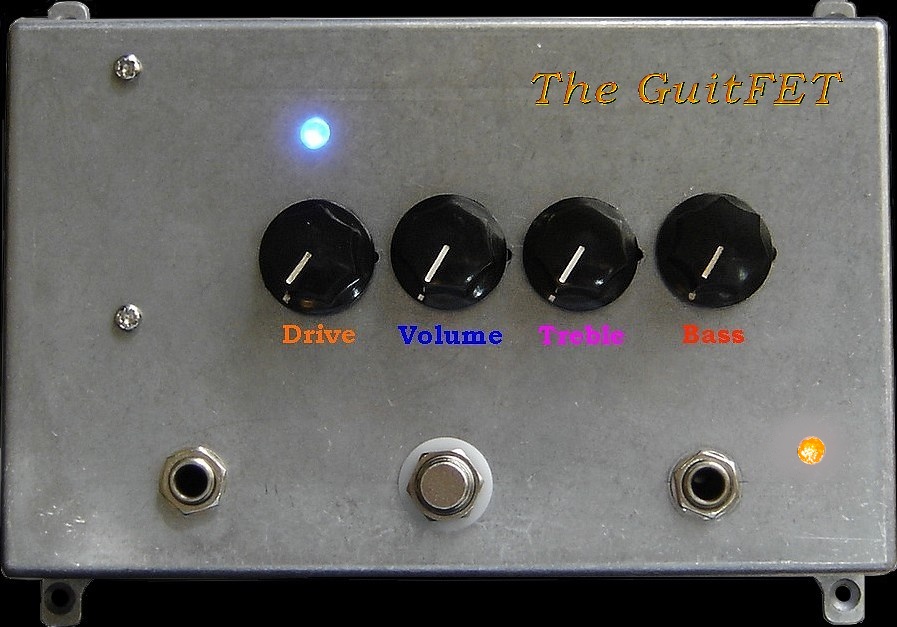
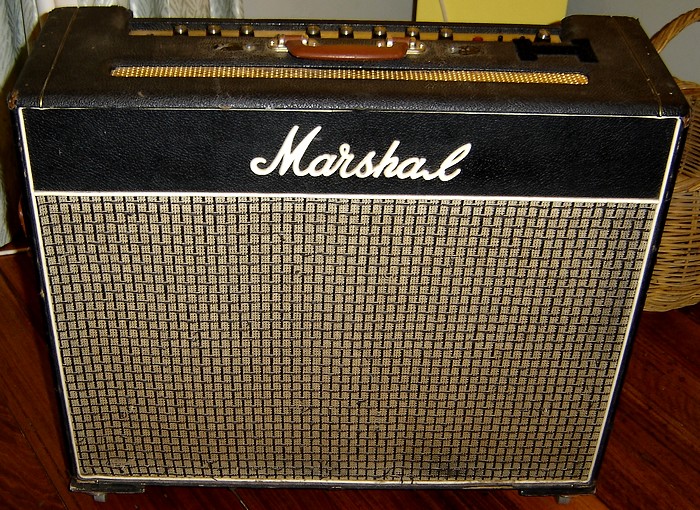
The 'GuitFET' is a vibrant sounding guitar pre-amp with overdrive capability using all discrete single-ended class 'A' circuitry. This preamp features an overdrive control that goes from almost totally clean to full tilt valve type distortion, with the added advantage of tone controls before the OD stage. It has an overall treble bias to keep the sound bright and lively, but ample treble cut as well. With the tone controls wound back it produces a mellow but cutting 50's type middy sound reminiscent of the early 50's R&B records. It also sports a true bypass stomp switch of course. It uses a FET transistor on the high Z input, and utilizes bass / treble tone controls before a level controlled FET overdrive stage. There is also a master volume output control of course. It is a simplified version of one I made many years ago which also had an input level control as well. It runs on mains power, and has the usual true bypass foot switch. It is configured (using a dual gang pot) so that the volume out does not increase significantly when the overdrive level is increased. I originally embarked on the project because I was using, and still use, an old Marshall combo (pictured below ) which has no natural breakup or overdrive capability. With a guitar going straight into it, it sounds like a guitar being played in a rainwater tank! It's a very warm sound, but not "quick" enough to play live in a typical R&R band. I was never happy with conventional pedals such as the Boss OD-1, Ibanez Tube Screamer or the even the DOD-250 which was the best of them I thought. |
|
|
Originally I built a valve preamp (pictured right which worked quite well. It has heaps of gain and based on the same idea of tone controls before the OD stage. This one also has a small class 'A' output stage using a single 6BQ5. It's pretty groovy I think. Not a bad effort. All second hand parts of course... |
 |
|
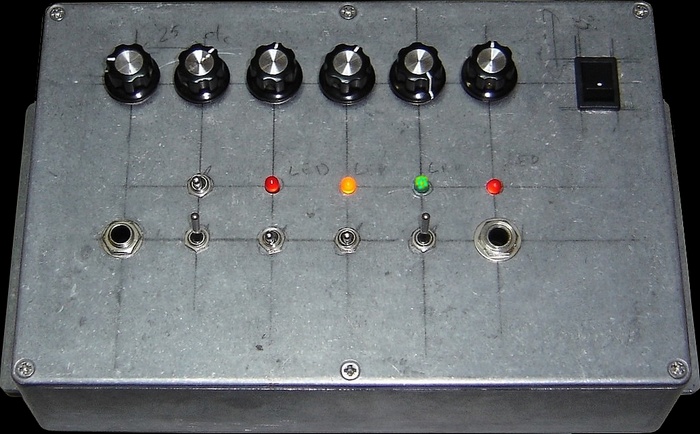
I wanted a pedal that sounded exactly like a valve amp over-driving from just a little bit, to a lot. The advantage of making a solid state one was that an experimental one could be knocked up on a 'breadboard' , and tweaked without laboriously de-soldering and re-soldering. I thought that using depletion FETs in the place a valves would replace a typical 12AX7 with the usual cathode bias configuration. I also thought that, in order to replicate the sound of a guitar amp driving, it needed to have tone controls before the OD stage. The original one (pictured right ->) certainly achieved my objective. It sounded better than my valve one. The unit is completely transparent when used just as tone controls with little or no OD. The OD sound is quite velvety, but cuts through. It is also an excellent bass preamp for recording. I have been using it for so long now, the original plastic case disintegrated, forcing me to transplant the works into a new alloy case. I built it in around '94 - '95 and used 2nd hand transistors and capacitors from old VCR boards and the like (I was skint). The original FETs were MPF102s from Dick Smith Electronics back when they still sold such things in a shop. It took a lot of tweaking and changing to get right however. One of the obstacles with using capacitor coupled single ended amplification stages is the when overload occurs, it changes the DC conditions around the circuit stages for a short time, causing a "blipping" noise before each note, particularly on high notes. This has to be overcome with compromises in the time constant (or low frequency roll off) of the coupling of each stage. This is where trial and error and listening come into play. Maths alone won't do it... Care must also be taken to prevent the regular bipolar transistors from distorting as this can produce nasties. This one did not have a bypass foot switch. |
 |
|
At right is the latest version. Just click on the pic for the full res pdf version. |
|
|
At right, the vero board layout as built. Just click on the pic for the full res pdf version. The copper breaks are scalloped out with a 5/32 drill bit with a rubber band wrapped around as a handle.
|
|
|
My old '72 Marshall combo with Hammond reverb tank. It's a real clunker. I have been told that they were really a bass guitar chassis, frocked up to sell off as 50 watt reverb combos, maybe to grab some sales from Fender. There aren't many around, and have been described on the Net as one of the 'least desirable' Marshalls. It has been a real asset for recording however because of the fact that, when coupled with the appropriate effects, can produce some great sounds, and has a huge bottom end. It's also rather novel having a spring reverb in a Marshall. An easy mod which improved the sound a lot is to disconnect the negative feedback. I have a switch on the back which allows the negative FB to be engaged or disengaged. It gives the amp more gain, a warmer sound, and a bit more attack, even though it negates the operation of the 'Presence' control. |
|
|
Both preamps I use have been constructed on vero board which is a bit of a nightmare but it does allow any changes to be made more easily. I have done quite a few gigs with this new one and and am quite happy with it. |
|
|
|
|
|
|
|
|
Pictured here on my pedal board with my 'Trembletone' tremelo and home made DOD OD-250 overdrive, and finally through a basic old Boss DD-2.
|
|




 |
|
| kelvin@guitars-of-love.com |