Guitars of Love

Tandy 'Realistic' PZM mic pre-amp:
The Kelvin Fleming design which replaces the original battery/transformer module.
Click here to see my recent addition of two Beyerdynamic condensor mics to the wedge:
kelvin@guitars-of-love.com


|
Someone once said that "most men have one really good idea in a lifetime". Well, I can identify with that. I suspect this was mine... I am a huge fan of the affordable Pressure Zone Microphones (PZMs) sold by the 'Tandy Electronics' stores in the Eighties. They were badged under the 'Realistic' brand, and cost AU$79.95 each. I have used them for nearly thirty years for recording both live and at home for multi-track recordings.
Referred to now as 'boundary mics', they were a cheap copy of the Crown ones that cost ten times as much, and sell 2nd hand for prices comparable to what they would have cost new. In fact they used the very same piezo module as the Crown mics (see below). Every budget studio jumped on them straight away. The sound quality for the price was simply stunning. Much of the reason for this was that these type of mics don't suffer the phase cancellation that plagues conventional mics. They record from a point source in a small air gap, and are totally unidirectional in a 180 degree half sphere. Whilst recording with a band I was with in the '80s, I had the idea that the spatial information could be more focused by mounting the mics on a sturdy wooden wedge, with the mics placed at a distance much the same as the distance between a pair of ears. With this configuration the sound is recorded in two distinct unidirectional spheres, sliced down the middle; the same way people hear. I got the idea from the Sennheiser Dummy Head Stereo recording articles. It always struck me as banal the way studio engineers would stick an SM57 in front of an amp or whatever and the sound was flat and completely disengaging. We don't experience sound like this in every day life - why should we put up with it when trying to record? Much of the information we glean from sound is phasic. Anyway, the result was entirely affirmative. With a pair of headphones on, material recorded on these mics reproduces a three dimensional sound field in 360 degrees. The effect is amazing. For instance if the phone rings in another room and the recording is played back, even through loudspeakers the other room sound is reproduced with convincing presence. On headphones, the effect is quite scary and I often have to get up to see what's going on because it sounds like someone else is in the house! I became a total convert to idea that all recording should be done in true stereo, not mono tracks tricked up to sound like stereo. Rupert Neve had something to say about this... ...There was one studio that asked me to listen to a "wonderful recording" that they had made last week, and I asked if they'd ever thought of recording in stereo. They said, "it is stereo". I said, it's panned mono, you've panned the image to three different places. That's not stereo. Try doing it in stereo, at least have some of the material in stereo and you'll find the whole thing comes to life... |
 |
|
The Sennheiser Dummy Head Stereo recording was a huge breakthrough in the concept of recording at the time. It enabled the reproduction of 3D information as our ears perceive it.
|
 |
|
The other day I received an email from someone who happened upon this page. He reliably informed me that the Tandy PZMs and the Crown ones used identical piezo modules sourced from the same factory. Apparently the best ones were selected for the Crowns, and the rest were relegated to the cheap Tandy models. So there you have it - quality was spread to the masses because it was probably seen as a good commercial opportunity to 'minimize waste'! The modules are just screwed to the hard metal plates and some of them stripped so I glued them on with two part epoxy. The wooden wedges are reinforced with massive oregon pieces at the back. These mics have a particular sound characterised by vibrancy and warmth. They are a bit distorted by audiophile standards but the spatial information makes up for it. Many of the overdubs on the 'Sheds' album were done with this device, and you can here the mics picking up the acoustic qualities of some of the lead guitar as well as the sound from the guitar amps. |
One day I found one of the mics had failed, the problem being that the little audio transformer in the battery powered module had gone open circuit. This was a disaster for me! I bought some new type boundary mics from Radio Parts but I think they are a bit harsh - and still powered by a small lithium battery - with no on / off switch!. I decided that it would be good if I could replace the module with a powered preamp to both supply power to the PZM mic and retrieve the signal. I did this by supplying the mics with a small constant current Darlington circuit. It worked a treat. The preamp is noisier than the original ones (by about 8 - 10dB), but the the top end is smoother without the cheap audio transformers. The circuit is simple and you can build it for two bob. There are other circuits on the net with the same idea but the one I found asserts that the PZMs run with a +ve earth. This is totally wrong! I tried it and they just fizzle - bad news for a piezo... Fortunately there was no damage when put around with a -ve earth again. The mics supply a signal out and get their power on the same single unbalanced wire. Just an earth shield and positive line. That's how come they need a constant current source, so that any fluctuation in current drawn is reflected back as a voltage variation. |
|
|
Click here, or on the image below for more detailed images 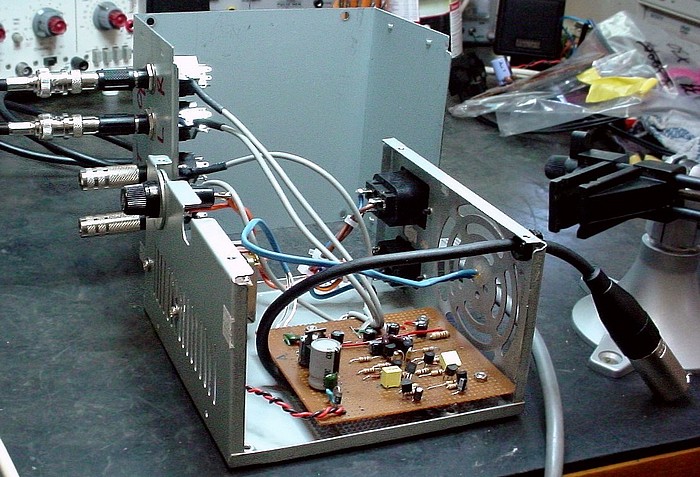 |
|
I built it into an old computer power supply box (right ->) with a small regulated +15V linear power supply. Originally I built the preamp with a 560 ohm emitter resistor on the output buffer giving the standard 600 ohm buffered output impedance for audio. To achieve phantom power operation the emitter resistor must be changed to 4.7K or more to keep current consumption down (a BC549C in the circuit.) With the base sitting between two 470K resistors as a voltage divider, this is easily achieved. Phantom power allows a maximum of 10mA or less. As shown balanced outputs can easily be added to the circuit if required, although I haven't actually physically built that circuit, so some values may need tweaking.
|
|



|
At right is the circuit I use with unbalanced outputs. |
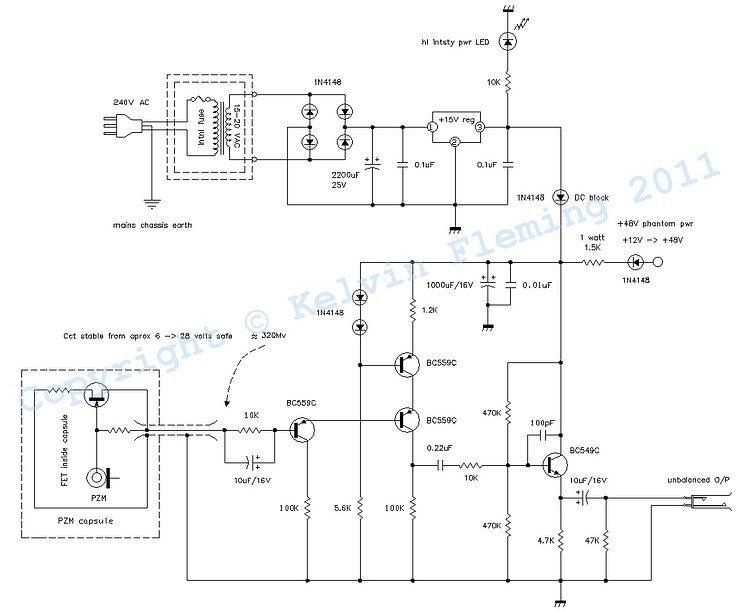 |
| At right is the circuit with a simple balanced addition. ( Circuit diagram © Kelvin Fleming 2011) |
 |
 |
|
| kelvin@guitars-of-love.com |